Lectio:
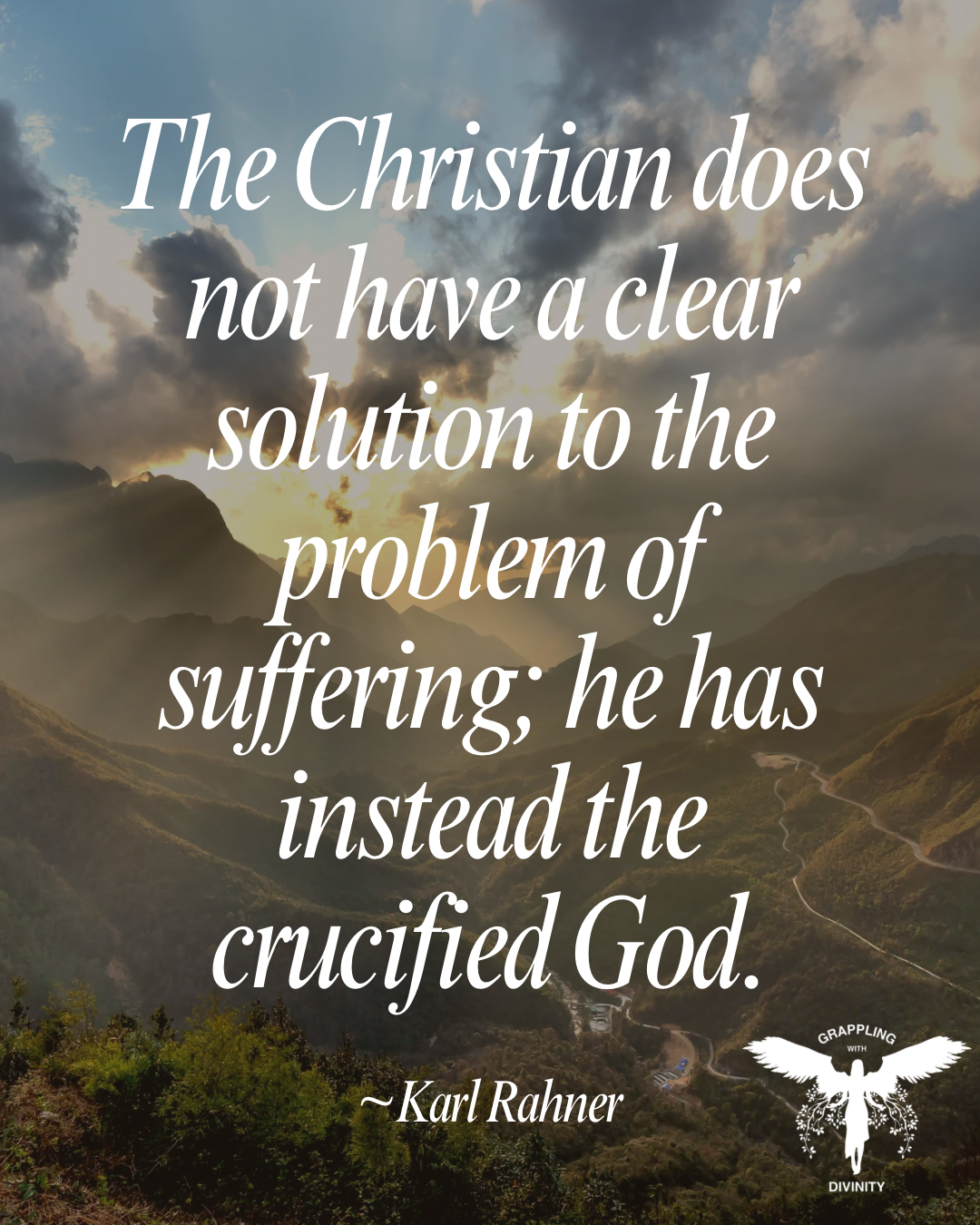
“The Christian does not have a clear solution to the problem of suffering; he has instead the crucified God.”
— Karl Rahner, Theological Investigations, Vol. 19

Meditatio:
Many of us come to Christ through suffering — often of our own making. After years lived on our own terms, we awaken to the sobering realization that our best thoughts, our finest efforts, and our most determined striving did not bring us peace or fulfillment. On the contrary, they led only to desolation, isolation, and alienation from God and our fellows.
In a moment of graced clarity, love and pain meet within us like divine alchemy. Something breaks — or perhaps something finally opens — and we surrender. Or rather, we are “captured while wounded,” as a friend likes to say, by the God we denied, abandoned, and betrayed so many times before. Only then do we find that He never left, He never stopped loving us (Hebrews 13:5), and that it was His love that sustained us through our self-inflicted exile (Lamentations 3:22–23).
We discover that “while we were still sinners, Christ died for us” (Romans 5:8), and that the very desolation we feared became the doorway through which we returned to the Father (Luke 15:17–20). What we thought was abandonment was mercy. What we called freedom was exile. Beneath it all — steady, unmoved — Love remained (2 Timothy 2:13).
Through our surrender — like the thief upon the cross who repents, proclaims his faith, and is told he will live with Jesus in Paradise (Luke 23:42–43) — God begins to transform us. We are reborn, given new life, new hope, and new purpose. It is as if we were the walking dead and new life has now been breathed into our being. We are given true sight, true hearing, and a true voice. Our lives take on new meaning, and we are alive again for the first time since childhood.
Somewhere in our spiritual formation, however, we come to learn a hard truth: the spiritual life is not a life free of suffering. All of the same violence, hatred, and sickness still exist in the world. We will suffer illness, injury, tragedy, and loss. And though we may have thought that coming to Christ means that we will no longer suffer, the cross does not remove suffering; it reveals its meaning. To love is exactly to suffer. It is to give ourselves to suffering in and for love.
The difference now is that while we may not always feel God’s presence in our suffering — “My God, my God, why have You forsaken Me?” (Matthew 27:46) — we are not alone. We have a God who suffers with us, who suffers for us, and who transforms suffering into new life within us (2 Corinthians 4:16–17).
Oratio:
Confusion pierces my side.
My inadequacy spills out before me,
unprotected from pain,
questions dripping down my bleeding forehead.
And yet I believe.
And yet I believe.
Even with this bitterness on my tongue,
betrayal stinging my cracked lips,
I call out Your name.
I beg You for relief,
for meaning,
for presence.
I cry out,
Father, where are You?
Why have You forsaken me?
A cry yet unanswered.
My questions linger,
echoing over and over,
mocking my frailty.
And yet I believe.
And yet
I believe.

Contemplatio:
How does the crucified God transform the meaning of your suffering and draw you into deeper trust?
Related Scripture:
“The Lord is near to the brokenhearted and saves the crushed in spirit.” — Psalm 34:18
For Further Reading:
If you enjoyed this post, you may also like Lectio Divina: Valley Of Tears which explores how embracing God’s unbreakable love helps us face sorrow and challenges with courage and hope.
~Robert Van Valkenburgh
Grappling With Divinity.
Wrestling With God.
Returning To Love.


Leave a Reply