Lectio:

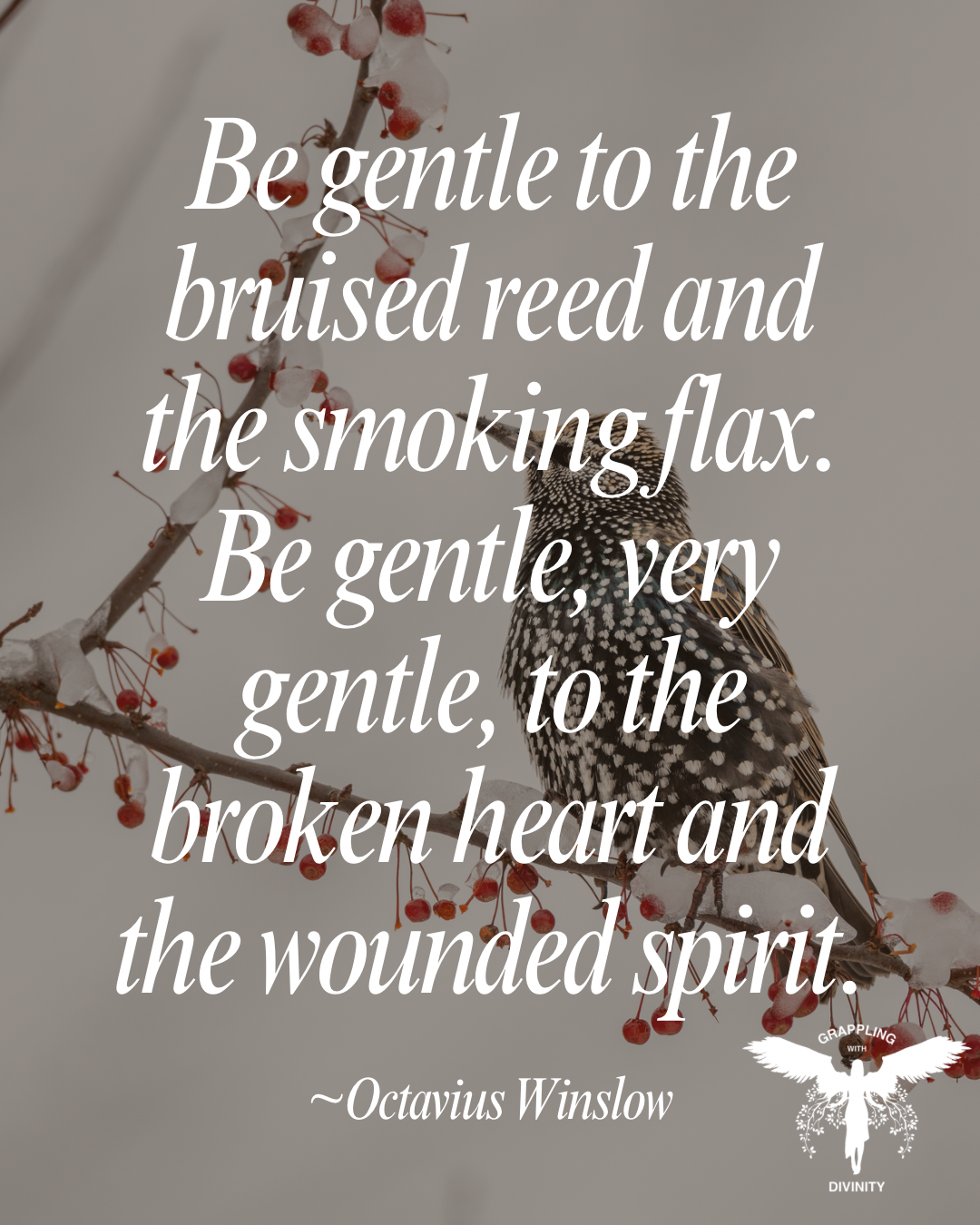
“Be gentle to the bruised reed and the smoking flax. Be gentle, very gentle, to the broken heart and the wounded spirit.”
— Octavius Winslow, The Burdened Gently Led By Christ
Meditatio:
It is difficult to say whether, as a species, our hearts are any harder now than they were in biblical times. Each generation tends to experience its own lifetime as the most difficult. How could it not be so? Ours is the only experience we truly have.
Though we may read about, hear of, or watch films and documentaries depicting eras more difficult than our own, we are separated from those hardships by time and space. Our troubles, challenges, and sufferings will always feel more real to us because they are happening to us.
For this reason, no matter how strong our faith or how deep our spiritual experiences, it is difficult to understand — at an embodied level — what it must have been like for Jesus, His mother, and His disciples at the crucifixion. Likewise, it is difficult for us to fully grasp the suffering of others.
Perhaps this is one reason we suffer.
I do not know.
But it seems that suffering has a way of making what once felt distant feel near.
Perhaps we suffer so that we can relate more deeply to the suffering of Christ and of our fellows (Hebrews 4:15). Perhaps we suffer so that, when we encounter someone else in pain, our hearts are softened just enough that, instead of remaining coldly detached, we can truly relate.
This is not to suggest that God causes our suffering simply so that we may better understand the suffering of others. God does not delight in our pain (Lamentations 3:33). Rather, He gives our suffering meaning. He uses it as a bridge — connecting us to the suffering of Christ and to the suffering of our neighbors. He uses it to draw us into deeper relationship with Himself and into deeper solidarity with those who are poor, afflicted, and in need (2 Corinthians 1:3–4).
Through suffering, we are drawn into humility, empathy, and gentleness. Our broken hearts become vessels through which love may be received and shared.
Of course, we have a say in the matter.
In the face of suffering, we may choose to harden our hearts — to become cynical, self-protective, and withdrawn — to build walls between ourselves, God, and others.
Or we may allow our pain to soften us —
to expose the places we protect most fiercely,
to uncover the ego that insists on control,
and to make us more vulnerable, more open to love.
Oratio:
Cotton candy sky,
I arise to greet you
with child’s eyes —
your clouded hues
of pinks and blues
peeking through the trees.
I needed your subtlety today.
I needed your softness,
for I am fragile,
vulnerable,
tender —
a wounded soul
that needs space
to breathe
to heal.

Contemplatio:
How might my own suffering become a way of opening my heart to the suffering of Christ and others rather than closing it off?
Related Scripture:
“Rejoice with those who rejoice; mourn with those who mourn.” (Romans 12:15)
For Further Reading:
If you enjoyed this post, you may also like Captured While Wounded: Finding Christ in Our Suffering
~Robert Van Valkenburgh
Grappling With Divinity.
Wrestling With God.
Returning To Love.


Leave a Reply