Lectio:

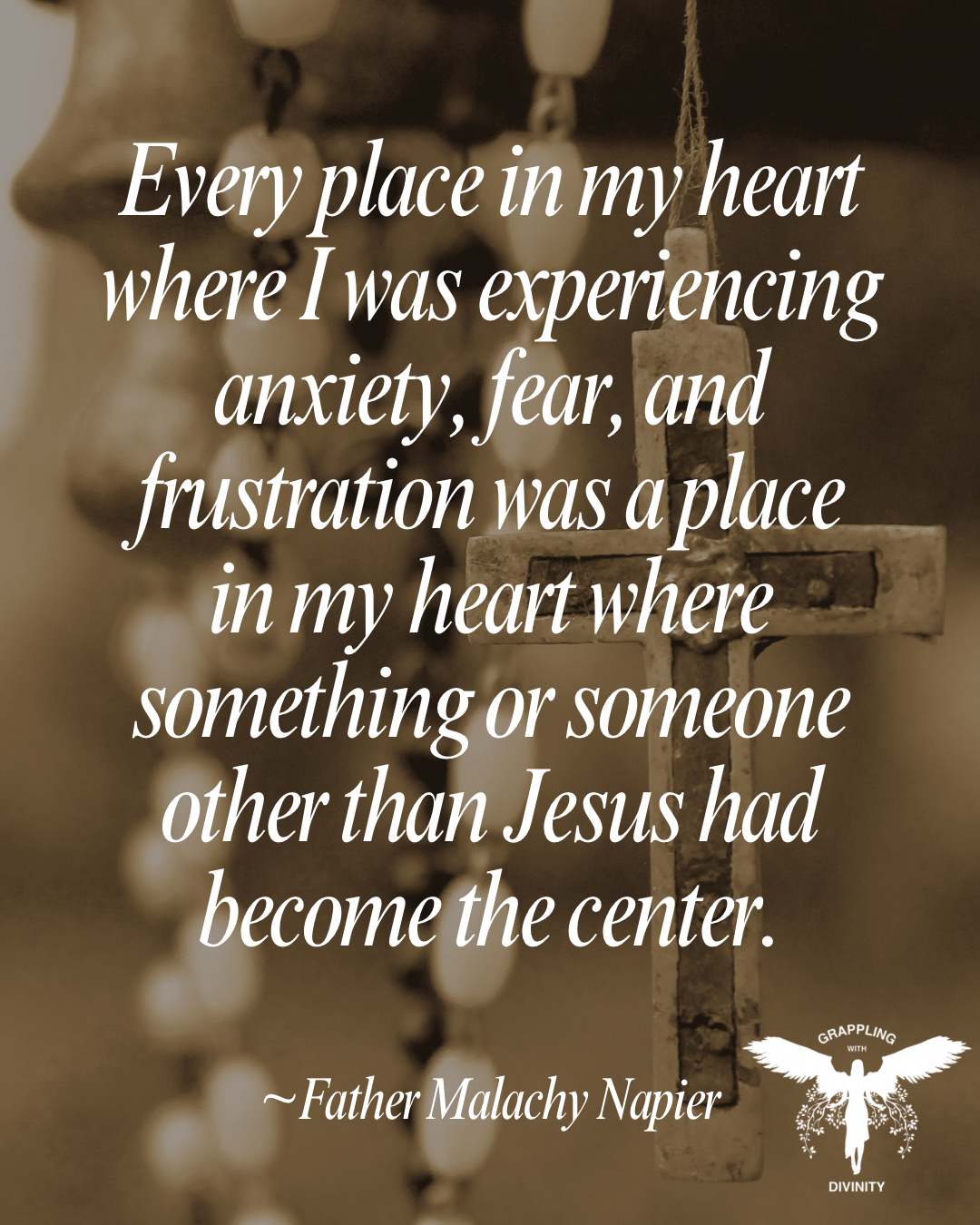
“Every place in my heart where I was experiencing anxiety, fear, and frustration was a place in my heart where something or someone other than Jesus had become the center.”
— Father Malachy Napier
Meditatio:
“But Jesus remained silent.”
— Matthew 26:63
“He was oppressed and afflicted, yet he did not open his mouth; he was led like a lamb to the slaughter, and as a sheep before its shearers is silent, so he did not open his mouth.”
— Isaiah 53:7
In the face of accusations, insults, mockery, and all other forms of verbal abuse, Jesus said nothing. He did not speak in His own defense, nor did He attack His accusers with harsh words of His own — and this in spite of the fact that He knew He was innocent, that He had done nothing to deserve such treatment, and that His persecutors were, in truth, far more guilty, unjust, and unholy than He ever was or ever would be.
And yet we, who are far from pure, just, or innocent ourselves, so often feel compelled, when our reputation, status, or character are attacked, not only to defend ourselves but to attack our attackers — to “return evil for evil” (Romans 12:17) — whether directly or indirectly, explicitly or implicitly. We have this sense that an attack on our person is an attack on our identity, that words are able to injure or alter the very fabric of our being, and that if we do not protect or defend ourselves, our identity — and therefore our security — will be lost.
But we are not who or what others think or say we are. We are not even who or what we think or say we are. Our true identity — our divine nature, the imago Dei — can be neither named nor changed by mere thoughts or words.
That place within us which was formed in and as the image and likeness of God (Genesis 1:26), and breathed into with the Spirit of Life, Love, and Truth (John 20:22), does not need protecting — at least not from words. While everything about who we perceive ourselves to be feels fragile, vulnerable, and susceptible to change, the truth of our being — that we were made in, from, and for Love — remains strong, steadfast, and reliable.
We need only understand, in our heart of hearts, that the part of us that can be hurt by words or beliefs is not the part of us where God abides. The part of us that is easily offended or angered is not the part of us within which God lives. The part of us that is made cold and cynical by the actions or words of others is not the part of us that was made in, from, and for Love.
The part of us that is our true identity — that can neither be seen nor named, insulted nor offended, injured nor angered — is the part of us that is eternal. It is Christ. If we believe this with all of our heart, mind, and strength, we will have attained eternal life, because once we become the part of ourselves that is not of ourselves — that was never born and can never die — we will have discovered eternal life in, through, and with Christ (John 17:3).
But this is not easy. It is the most difficult thing of all. Only grace, it seems, can bring us to this point. In the meantime, we remain offended, insulted, and angered — divided by sin from the eternal truth of who we are.
We do not have to speak or act on these feelings, however. We, like Jesus, can remain silent, entrusting who we are to the God who, alone, can name us.
The very desire to heal — to not bring more brokenness into the world through retaliation — is itself a sign that grace has already begun transforming us in love, that our false self is passing away, and that we are being resurrected in and as our true nature in Christ.
Oratio:
Release me, Lord,
from all that I’ve allowed to name me
other than the name
of Love
that abides within me —
far beneath
all that can be attacked or assaulted,
mocked or maimed,
denigrated or destroyed.
Release me from the self I think I am,
who is so easily offended and injured,
wounded and weary,
angered and irritated.
Release me, Lord.
I cannot free myself
from myself.
Release me, Lord,
until all that remains
is Love.

Contemplatio:
What would it feel like to rest in the part of you that cannot be named, injured, or taken away — the place where only Love remains?
Related Scripture:
“For you have died, and your life is hidden with Christ in God.” — Colossians 3:3
For Further Reading:
If you enjoyed this post, you may also like In God And God In Us: Reflecting On Divine Union And The Brokenness Of Our Hardened Hearts (Lectio Divina)
~Robert Van Valkenburgh
Grappling With Divinity.
Wrestling With God.
Returning To Love.
Leave a Reply