Lectio

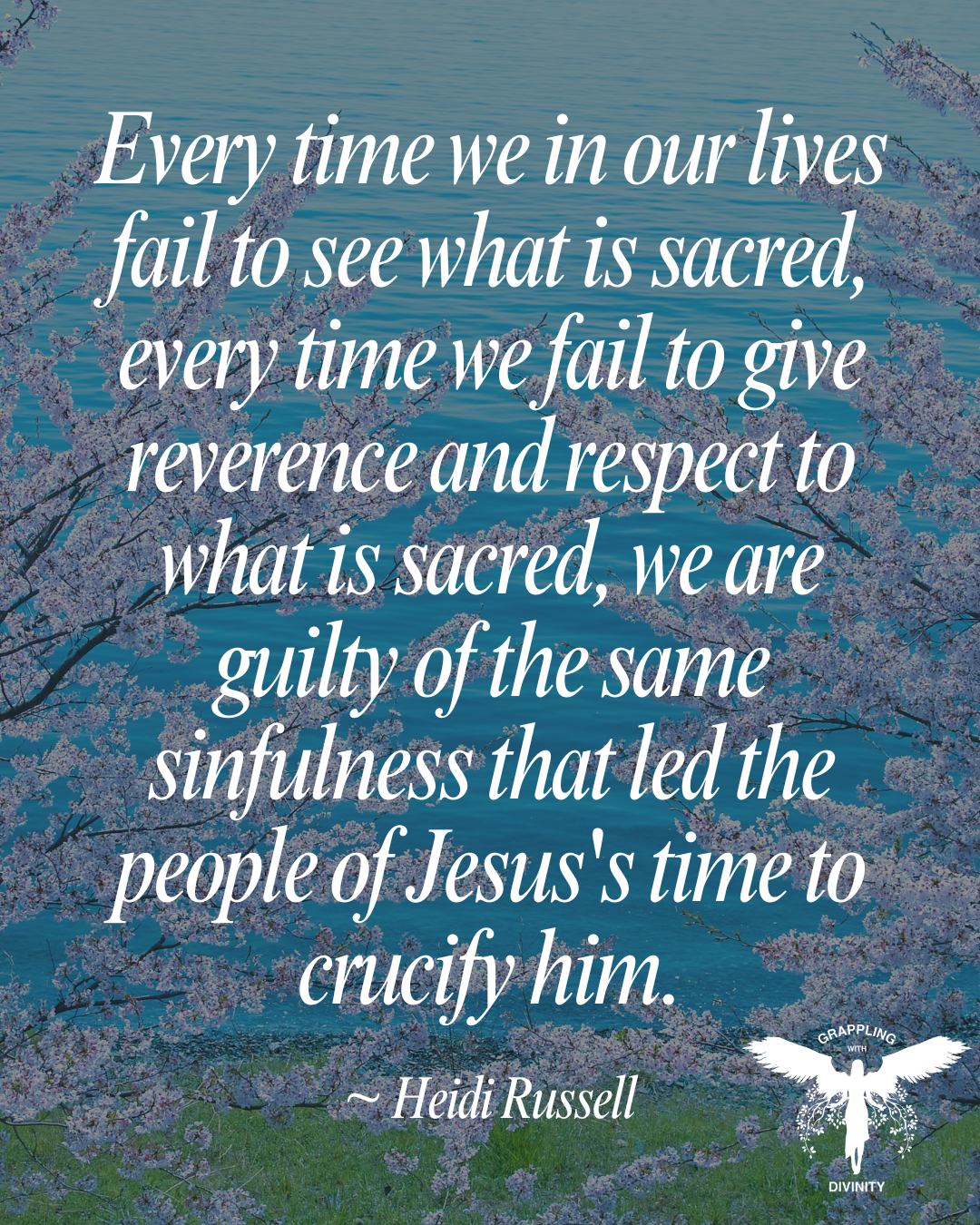
“Every time we in our lives fail to see what is sacred, every time we fail to give reverence and respect to what is sacred, we are guilty of the same sinfulness that led the people of Jesus’s time to crucify him. Every time in our own lives we fail to recognize God in our midst, we crucify Christ. We crucify Christ in our blindness or apathy towards the suffering of the innocent.”
— Heidi Russell, “On the Christology of Karl Rahner,” lecture, Loyola University Chicago
Meditatio
Where does a tree begin. Does it begin at its roots? At the nut or seed from which it first sprouted? Or does it begin at the water, soil, carbon dioxide, and sunlight that made it possible for the seed to sprout? But where does the water begin? The soil? The carbon dioxide? The sunlight?
And where does a tree end? Does it end at the tips of its branches, or at the leaves, flowers, nuts, or seeds that grow on those branches? Or does the tree end where the leaves fall and become soil, where the pollen of its flowers become a bee’s honey, where the nuts and seeds become food or other trees, or where the oxygen it breathes out becomes some other creature’s breath? But where do the leaves end? The flowers? The nuts and seeds? The oxygen?
Our lives are like the trees. They began long before we took our first breath, had our first thought, or spoke our first word. They began long before we formed in the womb, long before our parents conceived us, and long before they were conceived themselves. Our lives are an extension of the very first act of creation, but even creation began before that moment, in the mind of God. It began, we began, in the mind of God, as a thought, a desire, a word spoken in and as love by the source of all that is — a love that always intended to take on flesh, to walk with us, to live with us.
And our lives do not end where and when we end. Every thought, word, action, and breath ripples out into the world, affecting everything else. For better or worse, everything we think, do, or say changes the world, the universe, the cosmos. We are the very cosmos whose lives are affected by and affect the entirety of the cosmos. And even after we take our last breath, our presence lingers, echoing through time and space into the very eternity from which we came.
To lose sight of this is to lose sight of the God who is not merely among us but is the very ground of what we are and share — a ground embodied in Jesus of Nazareth, as Christ, so that we might finally see it.
When we fail to acknowledge this, when, out of pride, ignorance, or arrogance we cannot or will not see that our origin is in God, that our life is a reverberation of the word of God self-communicated in and as our very life, and that our destiny is to return to God, we crucify the very God whose breath fills our lungs, whose blood moves through our veins, and whose essence is reflected in our souls. When we live as if our lives, our neighbors, and our cosmos do not matter, we say that God does not matter, that love does not matter, and, ultimately, that nothing matters, and in saying this, we kill the very God who gave and gives us life.
And yet, all of this — everything we experience and everything we don’t, and whether we acknowledge it or not — is God’s self-communicated gift of Godself spoken into being, willed into being, loved into being, for no other reason than that we may willingly accept that love and complete love’s circle by giving that love away just as God has done for and through us. To not consent to this love freely given is to crucify God, and to not freely give of this love freely given is to crucify God. But God’s mercy is never-ending, God’s grace forever outpouring, and no matter how many times we stray, we are always welcomed back — into the love that spoke us and continues to speak us into being, and into the arms of the Christ whose yes never wavered.
Oratio

As I lie here
still
silent
staring up at the trees
whose spring buds
hypnotically sway in the breeze
taunting me
comforting me
I want to have the words
to neatly contain
that which cannot be contained
I reach for meaning
I grasp for definition
I want to explain it
I want to understand it
but infinity evades me
even while calling me to itself
drawing me out
grounding me here
in the infinity of this fleeting moment
silent
still
I lie here
awaiting nothing
explaining nothing
lacking nothing
Contemplatio
What would it mean to live as if your every breath were a word God is still speaking?
Related Scripture
“In the beginning was the Word, and the Word was with God, and the Word was God. He was in the beginning with God. All things came into being through him, and without him not one thing came into being.” — John 1:1–3 (NRSVCE)
For Further Reading
If you enjoyed this post, you may also like When the Birds Sang: On Presence, Worry, and the Word Hidden in Creation, which explores how the natural world — a symphony of birdsong in the woods — can draw us out of anxiety and back into the presence of the God whose Word sings at the heart of all creation.
Robert Van Valkenburgh
Grappling With Divinity.
Wrestling With God.
Returning To Love.
Leave a Reply