Lectio

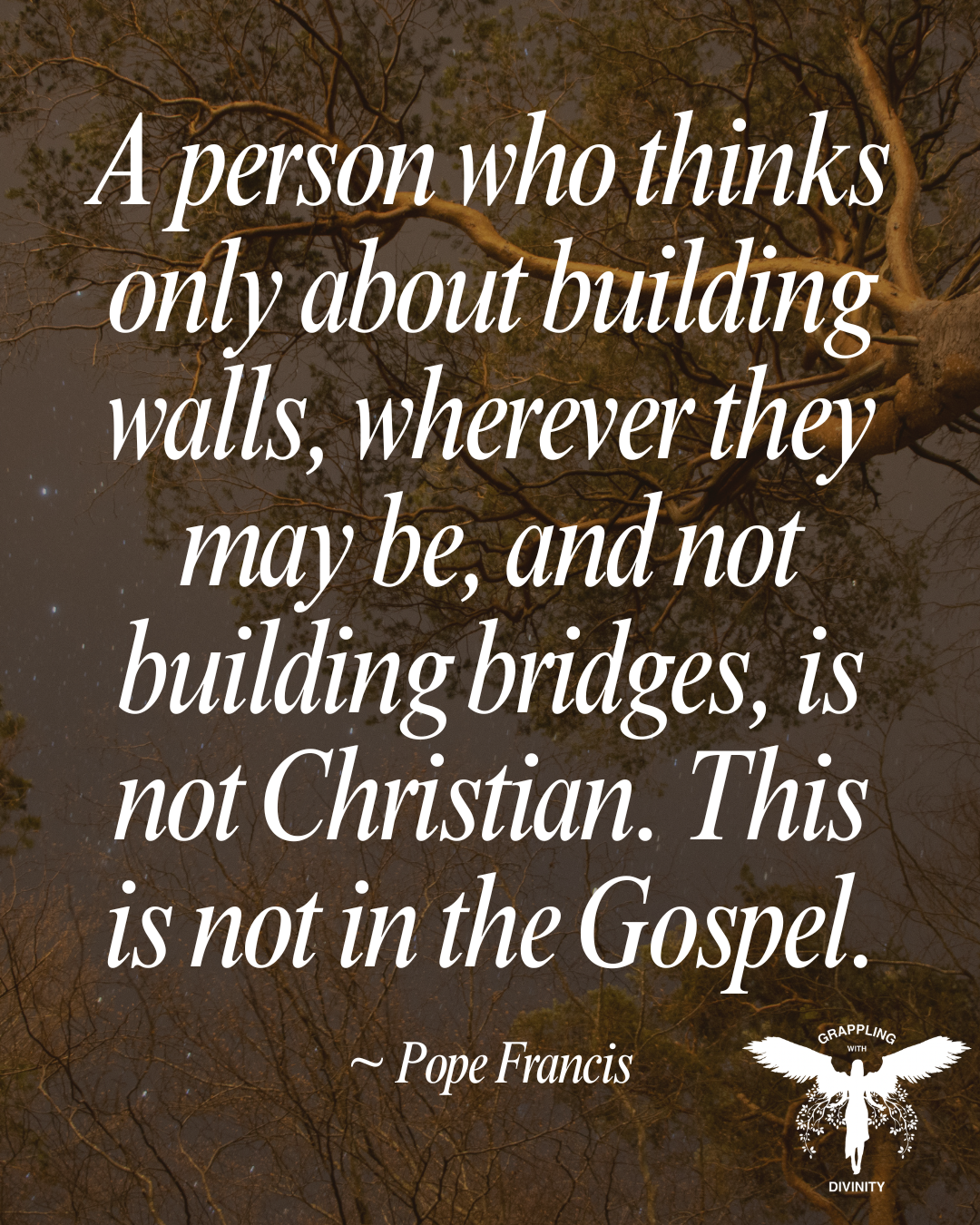
“A person who thinks only about building walls, wherever they may be, and not building bridges, is not Christian. This is not in the Gospel.”
— Pope Francis, as quoted by Cecilia González-Andrieu
Meditatio
The problem with walls is that they are meant to divide us from the perceived other — to keep our humanity away from the perceived non-humanity of those who are different from us. Walls are not always physical structures, however. We create psychological, emotional, and spiritual walls to separate ourselves from those we disagree with, dislike, or from whom we wish to protect ourselves.
These walls are our way of saying, “I am not like you, and, by building this boundary between us, I will be safely separated from your otherness.”
And, we always seem to believe that our side of the wall is the right side of the wall — that our side is noble, righteous, and good, and the other side is ignoble, immoral, and evil.
Christ’s message, however, was that these walls between us not only need to be broken down, but that they never even existed in the first place, outside of the hardness of our own hearts.
Whenever Jesus is approached by someone trying to “other” someone else, he uses it as a lesson to teach us to love our neighbors as ourselves — to have a charitable, non-judgmental, and accepting attitude toward others because they are not really other at all, but are our brothers and sisters and children of God — especially the sick, the poor, the needy, the immigrant, and the outcast. He tells us that to love our neighbors is tantamount to loving God, and loving God is the first, most important commandment. He even goes on to say that we must love our enemies — that we should even treat those who hate us like they are us, rather than separating ourselves from them, and treating them like an inhuman other.
And he did not simply preach this. Jesus lived it — again and again, and always across the very boundaries the world considers most necessary and divisive.
When he stopped at Jacob’s well and asked a Samaritan woman for a drink of water, he was crossing a wall his own people had built over centuries — the deep ethnic and religious enmity between Jews and Samaritans. She knew it too. How is it that you, a Jew, ask a drink of me, a woman of Samaria?” (John 4:9). He ignored the wall entirely, engaged her with love, as a full human being, and revealed himself to her before almost anyone else. The neighbor, here, was the one his culture had declared an enemy merely by the fact of the place of her birth.
When a Roman centurion came asking him to heal a servant, Jesus was standing before a representative of the very empire that occupied his homeland. He could have turned away, building a wall between himself and the soldier who asked for his help. Instead, he healed the servant without condition and held the soldier up as a model of faith — the outsider, the political other, the face of imperial power, welcomed without hesitation (Matthew 8:5–13).
When he looked up into a sycamore tree and saw Zacchaeus — a chief tax collector, a man who had grown wealthy collaborating with Rome at the expense of his own people — Jesus did not wait for repentance or restitution. He invited himself to dinner. The transformation came after the welcome, not as its condition. The wall of moral judgment dissolved in the simple act of sitting down to eat together (Luke 19:1–10).
And then there is the encounter that contains them all. A woman is dragged before Jesus by a crowd already holding stones — her guilt publicly declared, her fate already decided. The wall here is not merely social or ethnic or political. It is the wall of righteousness itself, weaponized. The crowd is not wrong that the Law permits what they are about to do. They are wrong that their side of the wall is the right side. Jesus does not argue. He does not lecture. He kneels down and writes in the dirt, and then says the one thing that no wall can survive: Let anyone among you who is without sin be the first to throw a stone at her (John 8:7). One by one, they leave. And to the woman, when they are gone: Neither do I condemn you. Go your way, and from now on do not sin again. (John 8:11). Jesus did not show indifference to what she had done. He did not ignore it or wipe it away. He acknowledged her sins with mercy — offered first, freely, without condition.
Ethnic walls, political walls, moral walls, religious walls — Jesus walked through all of them, not because he was naive about human sin and division, but because he knew something his accusers did not: that the wall was never load-bearing. It was only ever held up by the hardness of human hearts. And a heart broken open by love has no need of walls because there is no “other.”
This is why it is worth pausing over the very quote with which we began. When Pope Francisco says that those who build walls “are not Christian,” he is — however unintentionally — building a wall of his own, drawing a boundary between the wall-builders and “real Christians,” between those who are in and those who are out. And if we nod along too eagerly, too satisfied with which side of that line we find ourselves on, we may be picking up a stone of our own. The teaching has a way of turning back on everyone who encounters it. Even — perhaps especially — on those of us who most love to quote it.
But this, too, is part of the gospel. The woman’s accusers were not condemned. They were invited to look at themselves, and they walked away. We do not know what happened to them after that. We can hope they went home a little lighter, a little less certain of their righteousness, a little more tender toward their own poverty. That is what the encounter with Christ seems to do — not harden the verdict, but soften the heart. And so the circle widens, until there is no one left outside it. Not the wall-builders. Not the pope. Not us.
Oratio

i want you to know
that i love you
to feel it
to believe it
to trust it
but i don’t know how to say it
how to show it
how to sustain it
there is so much hurt
so much confusion
hardened hearts between us
i don’t know what to do
i am on my knees
i am at my limits
i am begging
here am i
let it be
according to your word
i don’t want to live
with these walls
anymore
Contemplatio
Where in your life are you holding a stone — and what would it mean to set it down?
Related Scripture
“Let anyone among you who is without sin be the first to throw a stone at her.”
— John 8:7 (NRSVCE)
For Further Reading
If you enjoyed this post, you may also like Lectio Divina: Plea For The Weak, which explores Dietrich Bonhoeffer’s call for Christianity to stand in solidarity with the vulnerable and the outcast — the very people Jesus crossed every wall to reach.
Robert Van Valkenburgh
Grappling With Divinity.
Wrestling With God.
Returning To Love.
Leave a Reply