Lectio:

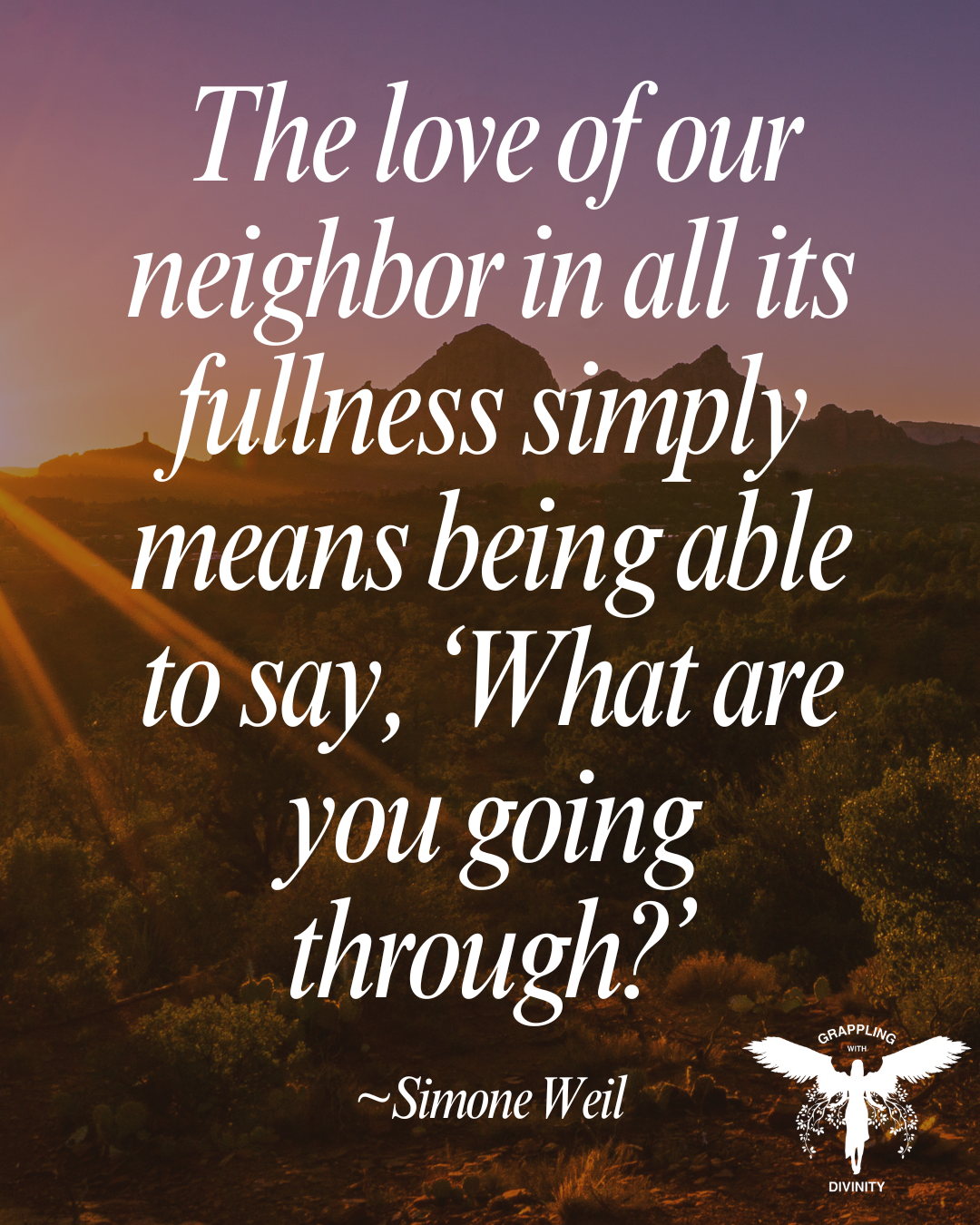
“The love of our neighbor in all its fullness simply means being able to say, ‘What are you going through?’”
— Simone Weil, Waiting for God
Meditatio:
When Bartimaeus, a blind beggar, hears that Jesus is nearby, he cries out to Him several times: “Jesus, Son of David, have mercy on me!”
The crowd — many of whom likely know Bartimaeus and are tired of this man they consider a nuisance — tells him to be quiet, to keep his problems to himself.
But Jesus hears him and calls him through the crowd, asking, “What do you want me to do for you?”
Bartimaeus answers, “My teacher, let me see again.” Jesus restores his sight, telling him that his faith has made him well — that his faith has saved him. Bartimaeus, receiving the mercy he asked for, begins to follow Jesus and to glorify God, which inspires the crowd also to praise God (Mark 10:46-52; Luke 18:35-43, NRSVCE).
The story of blind Bartimaeus not only teaches us the path to healing and salvation through faith and repentance, but also shows us how we are to love one another — especially the poor, the needy, and the afflicted.
The first thing we notice is that Bartimaeus, without having seen Jesus or witnessed any of His miracles, cries out to Him in faith, proclaiming Him to be the Messiah — the “Son of David,” the son of God foretold in 2 Samuel 7. This cry of faith captures Jesus’s attention, and He calls Bartimaeus through the crowd.
But his cry is not only a cry of faith.
“Have mercy on me!” he exclaims, repeatedly.
Bartimaeus believed that Jesus was capable of healing him, and he also believed himself unworthy of that healing — and therefore in need of the mercy of God.
The crowd, which has likely walked past Bartimaeus for a long time — blind, suffering, and begging on the roadside — tries to silence him and ignore him, as they probably always have. In their eyes, he is not worthy of attention, not worthy of healing, not worthy of Jesus’s love.
And yet, in spite of what they say — things he most likely believed about himself, to one degree or another — his faith gives him the courage to cry out to the Son of God for mercy, even as those around him mock him for it.
Bartimaeus had confessed his faith and repentance for all to hear. And still Jesus asked him, “What do you want me to do for you?”
Why?
Surely Jesus knew what Bartimaeus wanted. Surely the Son of God could see that this man was blind and longed to be healed.
But He asked anyway.
Perhaps it is because God awaits our consent. He will not impose Himself on us, for, as James Finley writes, “That which is essential never imposes itself, for love is always offered. It’s never imposed.”
Perhaps Jesus also wants Bartimaeus to acknowledge to himself what he truly wants — to admit that he longs to be loved, to be healed, and to be made whole through faith.
This does not mean that faith will heal all of our wounds, ailments, or disabilities. We can be made whole in and through God even in our physical and emotional brokenness. Quite often, God uses our differences — the things we or others feel that we lack — to His own purpose, and through this we experience a healing and wholeness that has nothing to do with looking, feeling, or thinking like everyone else (2 Corinthians 12:9-10).
In the case of Bartimaeus, there does seem to be a spiritual dimension to his healing. When Jesus tells him that his faith has saved him, the word “saved” suggests something more than the restoration of physical sight — that in crying out for mercy, Bartimaeus was made whole in a way that went deeper than his eyes. Whether his blindness was a consequence of sin or simply the condition through which God chose to reveal His mercy, we cannot say with certainty. What we can say is that faith opened him — to Christ, to healing, and to a wholeness the world had told him he could never have.
But there is something else present in Jesus’s question.
As Simone Weil observed, to ask another person sincerely — “What are you going through? What do you want me to do for you?” — may lie at the very heart of what it means to love our neighbors as God loves us (Matthew 22:39).
Hidden in plain sight, Jesus is demonstrating the second great commandment. Without saying so, He is teaching us that when someone cries out because they are cold, hungry, thirsty, unclothed, unhoused, persecuted, imprisoned, or simply in pain, we are to ask — with love and sincerity — “What can I do for you? How can I help you?” (Matthew 25:35-40).
And what of the crowd — the same crowd that tried to silence him? Luke tells us that when Bartimaeus received his sight and began to follow Jesus, all the people, seeing it, gave praise to God (Luke 18:43). The ones who had pushed him down became witnesses to his healing, and his healing moved them. This, too, is part of what the story teaches us.
When we stop to ask — truly ask — “What do you want me to do for you?” — we do not only change the life of the one in front of us. We change the lives of everyone whose life will be touched by that person, including our own.
Oratio:
I am cold.
I am thirsty,
aching with an insatiable hunger.
Anonymous.
Alone.
Without warmth
or shelter.
The cruel winter wind
rips through my invisible body.
I am the sick,
the outcast,
the unwanted stranger.
I Am
the least
of these.

Contemplatio:
When someone cries out to you — from poverty, from pain, from the margins of your life — do you ask them what they need, or do you walk past in silence?
Related Scripture:
“Is it not to share your bread with the hungry and bring the homeless poor into your house; when you see the naked, to cover him, and not to hide yourself from your own flesh?”
— Isaiah 58:7 (NRSVCE)
For Further Reading:
If you enjoyed this post, you may also like Lectio Divina: Plea For The Weak, which explores Dietrich Bonhoeffer’s call for Christianity to stand with the vulnerable and protest systems of indifference — a fitting companion to Jesus’s demonstration of that same love in His encounter with Bartimaeus.
~Robert Van Valkenburgh
Grappling With Divinity.
Wrestling With God.
Returning To Love.
Leave a Reply to Where Light Enters: The Wounds of Christ and the Wounds We Carry (Lectio Divina) | Grappling With DivinityCancel reply